80% Have Adopted Agentic AI — Why Is Scaling Still Hard?
~80% of the Fortune 500 have adopted agentic AI, yet many stay stuck in isolated pilots. We break down the organization, governance, and measurement gaps between pilot and scale — with data from MIT Technology Review, Hisense, and QbitAI — and a five-step path to production.
From Pilot to Whole Company: The Organizational Path to Scaling Agentic AI
TL;DR: Roughly 80% of the Fortune 500 have already adopted agentic AI, yet — as MIT Technology Review reports — "progress toward meaningful scale remains uneven, with many organizations still working through isolated pilots." The reason many efforts stall is almost never model capability. It's organizational: the pilot proves an agent can work, but nobody rebuilt the workflow, the knowledge base, or the governance around it. The key to scale is the inverse of how most pilots begin: tie every agent to a concrete business outcome, redesign the workflow first, and treat context and governance as the product — not the afterthought.
Why do so many enterprise AI projects get stuck at the pilot stage and never reach the whole company?
Because the hard part was never the demo. It's what surrounds the demo.
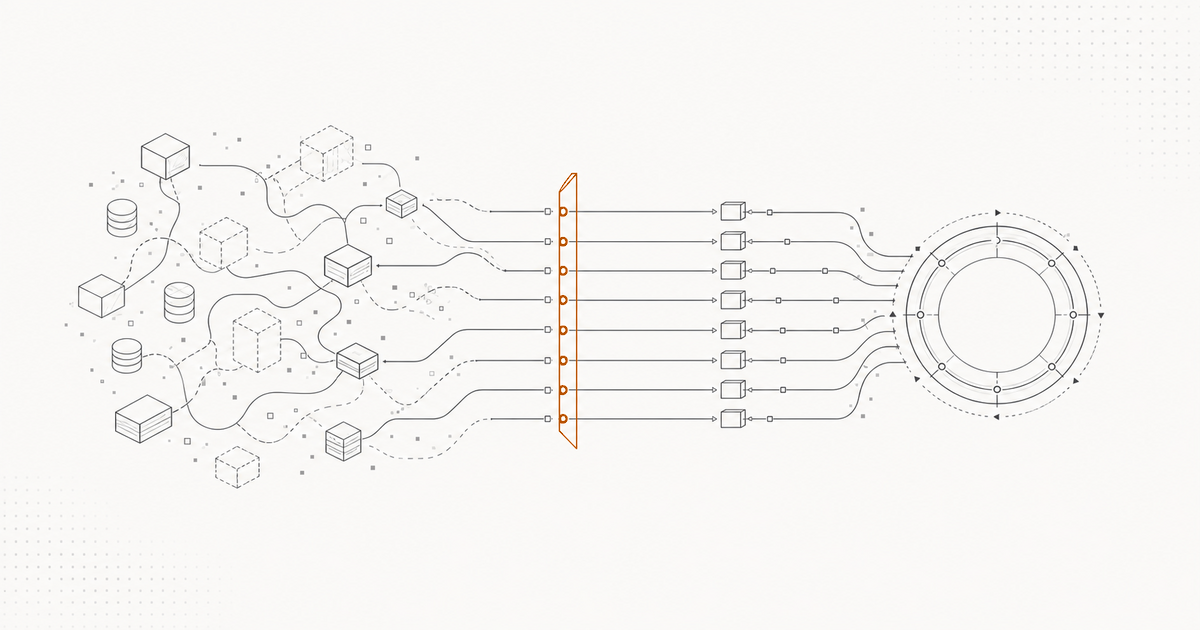
MIT Technology Review's analysis names the failure mode precisely: a "new kind of fragmentation," where individual teams stand up isolated systems that don't connect to one another. Each pilot looks like a win in isolation and adds up to a mess at scale. Arun Chandra, COO of NiCE, puts the root cause bluntly in the same piece: "The last thing you want to do is to apply AI on an outdated or an inefficient workflow." A pilot that bolts an agent onto a broken process just automates the brokenness faster.
The knowledge problem is just as concrete. In a Chinese-language InfoQ analysis of Hisense's rollout, the company ran ten pilots: brand-new systems saw development efficiency rise 3–4×, but agents helped little on legacy systems. The bottleneck wasn't that the AI couldn't write code — it was that "it doesn't know the history that was never written down." As the InfoQ piece observes, a human engineer who doesn't understand something will at least stop and ask; an AI that doesn't understand will often keep writing anyway, sometimes amplifying the hidden dependencies buried in old systems.
A word on a number you've probably seen: the widely circulated claim that "95% of enterprise AI projects fail" is an unverified figure that gets repeated far past what the evidence supports. The more defensible framing is MITTR's own: adoption is near-universal (~80% of the Fortune 500), but scaling is uneven, and many organizations are still working through isolated pilots. The problem isn't that AI doesn't work — it's that "works in a pilot" and "works across the company" are two very different engineering states.
Pilot vs. Scale: Where Do Organization, Governance, and Measurement Actually Differ?
The gap between a pilot and a production-scale deployment is not a matter of degree — it's a change in mindset across the organization. The table below maps where the two diverge.
| Dimension | Pilot stage | Scale stage | Source anchor |
|---|---|---|---|
| Goal | Experiment for its own sake; prove it "works" | Bound to business strategy (revenue, cost, financial outcomes) | MIT Technology Review |
| Workflow | Layer AI onto the existing process | Redesign the workflow first, then deploy the agent | MITTR (Chandra) |
| Knowledge / context | Relies on explicit documentation | Surfaces the undocumented, tacit history | InfoQ (Hisense) |
| Reach | Small-group trial (~hundreds of people) | Company-wide (Hisense: 900+ users) | InfoQ (Hisense) |
| Org structure | Each team builds its own island | Connected strategy; avoid new fragmentation | MITTR |
| Governance | Bolted on after the fact | Privacy, security, and change management up front; agents held to the same bar as people | MITTR |
| Measurement | Judge the demo | Track quantifiable output and real usage distribution | QbitAI / OpenAI cases |
Hisense's numbers make the "reach" row tangible: from an initial trial of nearly 100 people in February to a formal rollout that expanded past 900 users, serving a group with 46 product companies and 100+ self-built systems on a non-unified tech stack. MITTR frames the org-structure and governance rows as a "connected strategy" built around high-value use cases — and warns against trying to "boil the ocean." Its sharpest organizational recommendation: hold AI agents to the same performance standard as human employees, and think of your workforce as a combination of people and agents.
How do enterprises scale AI agents from pilot to production?
Not with a slogan. With five moves, in roughly this order:
- Tie the agent to business strategy and a measurable result. MITTR's first step to scale is getting past "experimentation for experimentation's sake" and binding each agent to a financial objective — revenue, cost, or another outcome you'd defend in a budget review.
- Redesign the workflow before you deploy. Chandra's warning again: don't apply AI to an inefficient workflow. Fix the process, then let the agent run it.
- Build the context and knowledge base as a first-class asset. MITTR is unambiguous here: "The efficacy of these AI agents is purely a function of the context, the knowledge, and the data they can ingest and use." An agent starved of context is a liability at scale, not an asset.
- Put governance in front, not behind. As agents take on more consequential work, privacy, security, and change management stop being optional.
- Start where the value concentrates and the pattern repeats.
That AI-native companies win by making the workflow itself the operating capability — rather than layering AI onto old processes — is the through-line of OpenAI's write-up on AI-native company workflows. And the payoff is measurable when it's done right: OpenAI reports that Legora used GPT-6 Astra to review 41 documents in minutes, and that law firm Gilbert + Tobin governed and scaled its AI use rather than leaving it to ad-hoc adoption. These are the kind of quantifiable outcomes that separate a scaled deployment from a permanent pilot.
Which department or scenario is the easiest place to start?
Engineering. Coding and debugging are the shortest path to a working agent, and the discipline you build there transfers.
The InfoQ Hisense analysis makes the transfer explicit: engineering agents and business agents share the same underlying stack — model invocation, context management, tool orchestration, task decomposition, execution feedback, quality validation, and permission control. The methodology a team hardens on AI coding — spec-driven development, closed-loop feedback, quality guardrails, and "knowledge dissolution" (surfacing tacit history) — ports directly to finance, supply-chain, production, and customer-service agents.
The usage data backs the starting point. A QbitAI report on China's office-agent user behavior (drawing on LobsterAI's million-plus user base) found that general "coding" and debugging is the single largest task category at 38.5%, and the software/IT industry contributes 38.9% of all agent tasks. If you're looking for the beachhead where agents already earn their keep, engineering is it. (A follow-up piece on treating engineering as the engine of enterprise AI transformation is coming as the second article in this series.)
How do you govern and measure at scale so it doesn't fall apart?
Scaling isn't "roll it out and walk away." It's governance and real-usage measurement, kept tight.
On governance, MITTR is direct: as agents take on more important work, privacy, security, and change management matter more, not less — and agents should be evaluated against the same standard as the people they work alongside. On measurement, the QbitAI report is a useful mirror for what real usage looks like at scale. It found a pronounced head effect: the top 20% of users consumed 87.4% of compute, and the top 5% alone accounted for 53.5% of tokens. Value concentrates in a small number of deep use cases — so scale toward where the leverage already is, not uniformly.
The same report surfaces a governance imperative most pilots never plan for: 12.2% of calls were not initiated by a human in real time, and a single scheduled instruction triggered an average of 64 model calls — six times the 10.6 calls of a manual task. "Unattended" operation is already here, which means your metrics and guardrails have to be automated. You cannot manually review what runs while everyone's asleep.
The 6AM View: Using FDE Engineering Discipline to Wire Pilots into Production
None of the above is a mystery. It's engineering discipline applied to a moving target — and it's the same discipline that carries a pilot across the gap to production.
The pattern the Hisense case describes — a shared engineering foundation, spec-driven work, closed-loop feedback, quality guardrails, knowledge dissolution, and permission control — is exactly what a forward-deployed engineering (FDE) practice brings to a deployment. The value isn't a demo that impresses in a boardroom; it's the unglamorous work of rebuilding the workflow, wiring in the context, and standing up the governance so the thing that worked for a hundred people keeps working for nine hundred. That's the difference between "works in a pilot" and "works across the company."
If you're weighing where your own efforts sit on the pilot-to-scale curve, a good first step is an AI-deployment diagnosis — an honest read on which workflows are ready to scale and which will just automate the brokenness faster.
Related reading:
- Why enterprise AI agents fail in production
- The enterprise AI adoption path: build vs. platform vs. FDE
- Enterprise agent platform deployment requirements
FAQ
Is it true that 95% of enterprise AI projects fail?
No — that figure is an unverified claim that circulates far past the evidence. The more defensible read comes from MIT Technology Review: roughly 80% of the Fortune 500 have adopted agentic AI, but scaling is uneven and many stay stuck in isolated pilots. The issue is scaling, not outright failure.
How do enterprises scale AI agents from pilot to production?
Tie each agent to a measurable business outcome, redesign the workflow before deploying, build context and knowledge as a first-class asset, put governance up front, and start where value concentrates. MITTR stresses agent efficacy is "purely a function of the context, the knowledge, and the data they can ingest" — so context is the work.
Which department should an enterprise use its first AI agent in?
Engineering. Coding and debugging are the shortest path to a working agent, and QbitAI data shows coding/debugging is the largest agent task category (38.5%). Per the InfoQ Hisense analysis, the discipline you build there — spec-driven work, guardrails, feedback loops — transfers directly to finance, supply-chain, and customer-service agents.