From Model Race to Value Loop: How AI FDE Delivery Drives Enterprise AI ROI in 2026
In 2026 a growing argument in enterprise AI is that the contest is no longer about who has the strongest model, but who can close the loop from tokens to business value. That's where the AI Forward Deployed Engineer (FDE) comes in — an on-site delivery model that vendors like Runjian price on the value it actually creates. Here's what an AI FDE is, how it compares with traditional outsourcing, and what verifiable, auditable delivery looks like in practice.
TL;DR — In 2026, a growing argument in enterprise AI is that the winner is no longer whoever has the strongest model, but whoever can close the loop from tokens to business value. One delivery model built explicitly around that loop is the AI FDE — the Forward Deployed Engineer: an engineer (or engineering team) embedded on the customer's site to co-discover use cases and ship measurable outcomes. In the model Chinese infrastructure vendor Runjian describes, that work is priced on the value actually created rather than on headcount or hours. If you're deciding how to deliver enterprise AI this year, the question shifts from "which model?" to "who closes the value loop, and how do we know it's working?"
What is an AI FDE (Forward Deployed Engineer / Value Growth Engineering, VGE)?
An AI Forward Deployed Engineer (FDE) is an engineer embedded directly inside the customer's environment whose job is not to hand over a model or a feature list, but to co-discover where AI creates value and to deliver that value end to end. The term comes from Palantir's playbook; Runjian is one Chinese vendor now using it in its own words.
At WAIC 2026, Runjian described exactly this model. In an interview published on 36Kr, the company laid out an "AI FDE (AI Forward Deployed Engineer) delivery model," which it internally names VGE — Value Growth Engineering (价值增长工程师). The mechanic is concrete: "dispatch an FDE team into the customer's site to jointly uncover AI use cases and value" alongside the business. That is the definition worth remembering: an FDE is not a vendor waiting for a requirements document — it's an embedded engineer who finds the value with you and is on the hook for realizing it.
The distinction matters because it reframes what you're actually buying. Traditional delivery sells you capacity (a model, a project, a number of engineer-hours). An FDE, in this model, sells you a closed loop — a path from raw AI capability to a verified business result you can put a number on.
Why is enterprise AI shifting from a "model capability race" to a "value loop" in 2026?
Because the bottleneck is moving. For two years the frontier was model capability; as capable models have become more widely available, the argument goes, the scarce skill becomes turning that model into value inside a messy real-world workflow. That's how industry voices at WAIC 2026 framed it — the contest is moving "from a model-capability race toward a value-loop capability race," with the focus shifting from training ever-larger models to landing them in production and creating application value.
The tell is in how the work gets paid for. Runjian says its "Apollo 11" cognitive base has already shipped seven or eight projects in manufacturing, and — crucially — that customers pay according to the economic value actually created, not by project or by day rate. That pricing model is only possible if you can measure the loop close: input tokens → deployed agent → a business outcome someone will sign off on. Where payment is tied to realized value, "we deployed a model" stops being a deliverable. The deliverable becomes the result.
This is also why "just buy a model" and "just deploy it" are no longer the whole story. If you're still weighing whether the hard part is the model or the delivery, our companion piece on why enterprise AI deployment is hard walks through where deployments actually break — and it's rarely the model.
FDE delivery vs. traditional outsourcing vs. an in-house team — how should enterprises choose?
Short answer: consider FDE delivery when you need results fast and lack in-house AI delivery experience; traditional IT outsourcing when requirements are well-defined and standardized; and an in-house AI team when AI is a long-term strategic capability and you have the budget and time to hire and season one. Enterprises may consider FDE first when the loop-closing skill is exactly what they don't yet have internally.
The comparison below describes the value-priced, audit-built-in FDE model as argued in this article and exemplified by Runjian's VGE approach — not a universal guarantee of every vendor who uses the "FDE" label.
| Dimension | FDE on-site delivery | Traditional IT outsourcing | In-house AI team |
|---|---|---|---|
| Delivery goal | A verifiable business value loop | A requirements list / hours delivered | Internal capability build-up |
| How you pay | By economic value actually created | Per project / per engineer-day | Fixed headcount cost |
| Use-case discovery | Co-created on-site with the business | Depends on the client to specify needs | Self-driven, constrained by hiring |
| Time to first value | Fast (arrives with methodology + productized capability) | Medium | Slow (hire + ramp + gel) |
| Reliability / auditability | Built-in (verifiable output + quantified residual risk) | Per contract SLA | Depends on team maturity |
| Best fit | Need fast results, short on AI delivery experience | Clear, standardized requirements | Long-term strategy, ample budget |
The choice isn't permanent. A common path is to bring in FDEs to close the first loops and transfer methodology, then stand up an in-house team once the patterns are proven. If your decision is really "build vs. buy vs. bring someone in," our deep dive on enterprise AI: build vs. buy in 2026 lays out the trade-offs in detail.
What does FDE delivery actually look like? (soul + skills + config, verifiable output, quantified risk)
This is where "value loop" stops being a slogan and becomes engineering. The best public write-up of what trustworthy agent delivery looks like is Ai2/Skylight's account of building Shippy, its AI for real-time maritime awareness. Its opening lesson is the whole thesis of FDE work: "the real work wasn't the model. It was building a system we could trust to be correct, to stay within its limits, and to hold up across a wide range of tasks." (Hugging Face blog)
Three ideas from that write-up map directly onto how an FDE ships value:
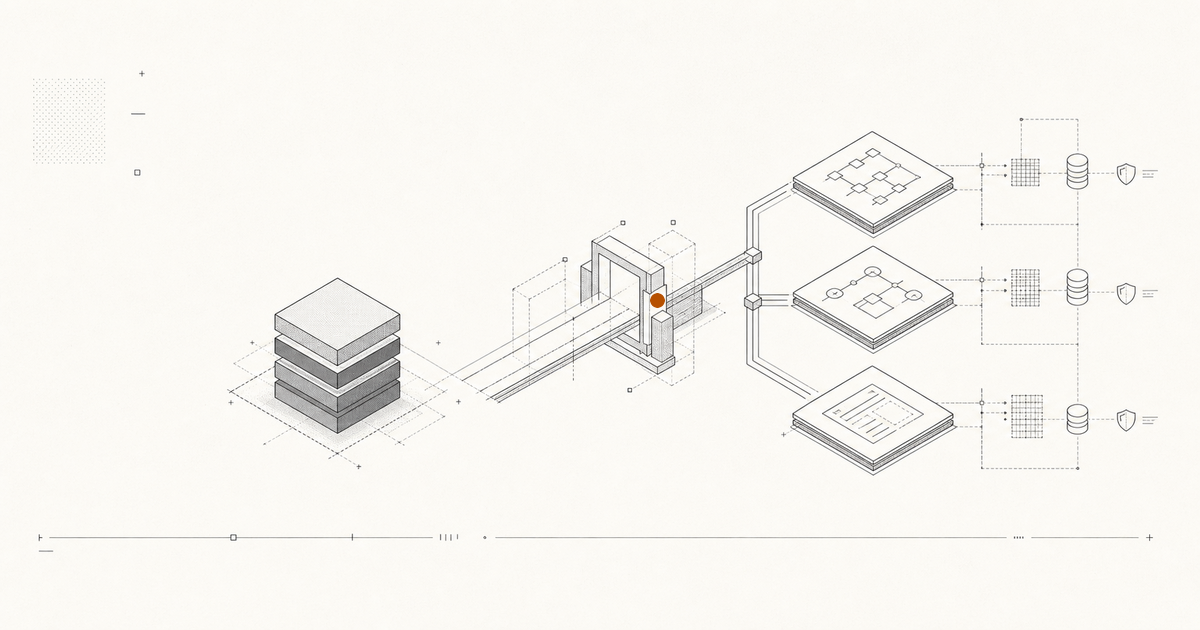
- An agent is soul + skills + config. The soul is the system prompt that frames the agent's persona and behavioral boundaries; skills tell it how to handle specific kinds of request; together they're "baked into a Docker image — a versioned, deployable artifact." Config is everything else: which harness runs it, which LLM it uses, and runtime settings. That separation is what makes delivery reproducible — you can ship, version, and audit an agent the way you'd ship software.
- Evaluate the agent, not the model. Static benchmarks rank models on frozen questions; they don't capture how an agent "selects tools, queries live data, acts on results, and knows where to stop." Skylight's answer was to score "the whole agent – model, skills, and sandbox together – against live data." For an FDE, this is the core competency: the thing you're accountable for is the system's behavior in the real workflow, not a leaderboard number.
- Verifiable output. In high-stakes answers, Shippy attaches "the boundary source, the data cutoff, the query timestamp, and a deep link back to the Skylight map so the analyst can verify every number." That's what "value you can trust" concretely means — every claim is traceable back to its source.
The missing piece is risk you can quantify. A recent arXiv paper, From Agent Failure Paths to Quantified Residual Risk, opens with the exact problem FDE delivery has to solve: "Agentic AI is crossing trust boundaries faster than current risk models can represent." Its framework decomposes an agentic system into a seven-layer integrity model it calls CPSAINT — Physical state, Sensors, Data, Compute, Actuators, Environment, and Time — and pairs it with FRIESA-K, a residual-risk function that maps each failure path to a quantified risk instance, deriving control effectiveness from an absorbing Markov model rather than an informal score. The authors show the same "layer grammar" holds across two very different deployments — a hard real-time warehouse robot and a governance-instrumented financial-services agent. For an FDE, that's the difference between "trust us, it's reliable" and "here is the residual risk, by layer, with numbers."
Put together, mature FDE delivery ships an agent as a versioned, auditable artifact, evaluates the whole system against live data, makes every output verifiable, and reports residual risk as a quantity — not a vibe.
What about data that can't leave your perimeter? On-prem and local-first delivery
For regulated and sensitive workloads — new-drug R&D, finance, embodied AI — the value loop has to close without data leaving the customer's perimeter. That's a data-sovereignty and infrastructure problem as much as a modeling one, and it's where on-prem, local-first delivery earns its keep.
Runjian's own infrastructure numbers make the case that private deployment no longer means giving up efficiency. In the same Runjian interview, the company reports its Runchan platform lifted token throughput by 700%, a self-built 480-megawatt dedicated substation cut compute cost by more than 30%, and microchannel liquid cooling plus 800V HVDC pushed PUE below 1.1. The point for an FDE engagement: you can run the loop inside the customer's walls, on efficient private infrastructure, and still hit the economics that used to require the public cloud. On this vendor's numbers, data sovereignty and value delivery are no longer a trade-off.
The bottom line
The 2026 enterprise AI question is no longer "which model?" — it's "who closes the loop from tokens to value, and how do we know it's working?" The AI FDE — the embedded, on-site delivery model that Runjian names Value Growth Engineering and prices on value created — is, this article argues, better positioned than traditional outsourcing to answer it. What makes it credible isn't a bigger model; it's delivery you can audit: agents shipped as versioned artifacts, evaluated as whole systems against live data, with verifiable outputs and residual risk reported as a number.
If you're weighing how to deliver AI this year, start by finding your value loops. Our AI deployment diagnosis helps you pinpoint where FDE-style delivery would pay off fastest, and our FAQ answers the common questions on FDE, pricing on value, and on-prem delivery.