What Is an AI FDE? From Selling Models and Tokens to On-Site Delivery and Value-Based Pricing
A comparison-table explainer of how the AI FDE model differs from outsourcing, license sales, and consulting — grounded in named 2026 enterprise data.
An AI FDE (AI Forward Deployed Engineer) is a delivery model in which engineers are embedded directly inside the customer's business — carrying their own tooling and compute — to co-discover AI use cases, deliver measurable results, and get paid on outcomes rather than on hours, licenses, or slide decks. It marks a shift in how enterprise AI is won: away from "whose model is stronger or whose tokens are cheaper," and toward "who can actually land the value and prove it."
This guide answers what an AI FDE is, how it differs from traditional IT outsourcing, license sales, and slide-deck consulting, why enterprises are moving toward value-based delivery, and what that looks like once it reaches the factory floor. If you only read one thing, read the comparison table below.
What is an AI FDE (Forward Deployed Engineer)?
An AI FDE is an engineer who deploys forward — into the customer's live operations rather than working from a vendor's office — and stays there to build, ship, and prove AI systems against the customer's real data and real business goals. The difference from ordinary on-site staffing is threefold: the FDE brings a tool-chain and compute, co-owns the outcome, and is paid on the value delivered, not on billed hours.
The clearest live example of the model comes from China. In a July 2026 36Kr interview, Runjian's board director and VP Ding Yong describes sending an FDE team "into the customer's site to jointly discover AI use cases and value" (per a July 2026 36Kr interview with Runjian). Runjian localizes the role under its own term — VGE, or Value Growth Engineering — but the mechanics are the FDE playbook: embed, discover, deliver, and price on results.
How is an AI FDE different from IT outsourcing, license sales, and consulting?
The core difference is where the risk sits and what actually gets handed over: outsourcing hands you software and hours, consulting hands you a plan, and an AI FDE hands you a running system plus the business result — and only bills when that result shows up. The table makes the contrast concrete.
AI FDE (on-site, value-based) vs. traditional IT outsourcing / license sales vs. slide-deck consulting
| Dimension | Traditional IT outsourcing / license sales | Slide-deck consulting | AI FDE — on-site, value-based |
|---|---|---|---|
| What is delivered | Software licenses, person-days, systems integration | Reports, slides, roadmaps | Running agents embedded in the customer's systems, plus measurable business outcomes |
| How it is priced | License fees, per person-day, per module | Per project or retainer | Priced on value delivered — the economic gain per token is quantified into a closed value loop |
| Who owns deployment risk | The customer (delivery ends at handover) | The customer (execution is out of scope) | Shared with the vendor — the FDE stays on-site and co-owns the result |
| How it is measured | Feature acceptance, SLAs | Hard to tie to business value | Measured in business metrics — capacity, throughput, cost — and verifiable |
This is where the FDE model and the classic build-vs-buy decision meet: outsourcing and licensing are a "buy" that stops at the handover, while an FDE engagement is a "buy" that stays accountable for the outcome. Runjian frames the same idea from the pricing side — quantifying "the economic benefit each token brings … and charging on the value result, forming a complete value loop" (per the July 2026 36Kr interview).
Why are enterprises shifting from selling models and tokens to value-based delivery?
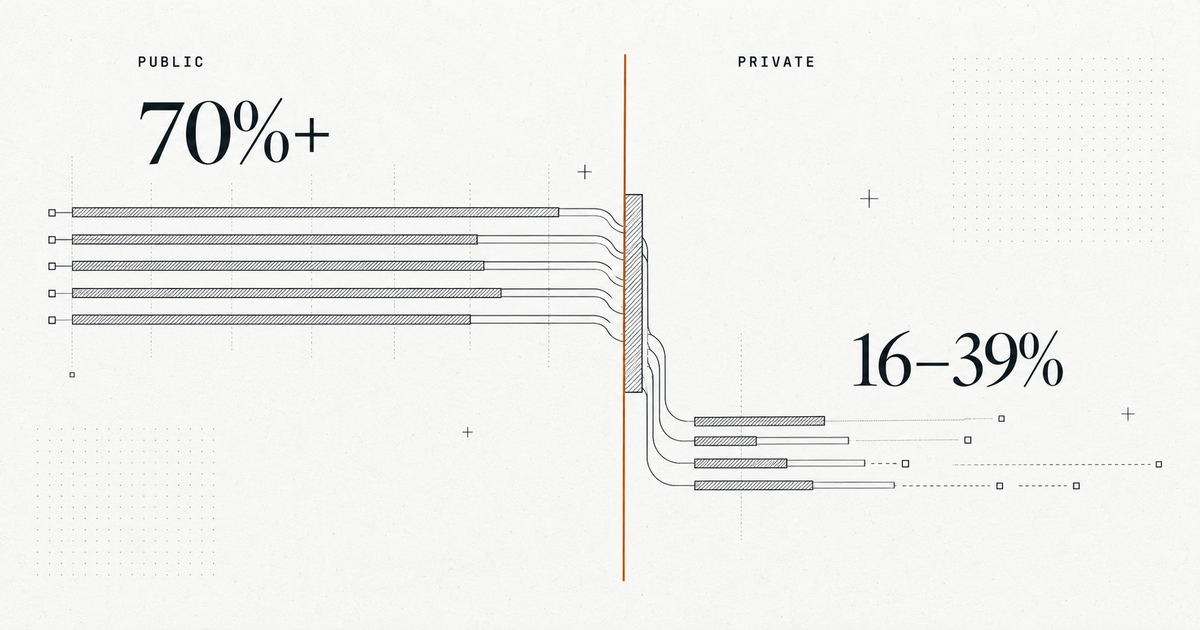
Because the market has stopped rewarding raw model capability and started rewarding proven delivery. The signal was loud at WAIC 2026. In its July 2026 field report, QbitAI summed up the mood as "AI Chat is now ordinary; being able to do the work and deliver is the new standard — Show me the Agent!" and noted that roughly 70% of exhibitors in Hall 1 made agents their default demo, with four of the ten "hall treasures" being agent applications (per QbitAI's July 2026 WAIC 2026 trends report). The same piece argues that "whether it can complete effective delivery is becoming the most concrete, most weighty standard for measuring a large model's capability" — parameter counts, it notes, are no longer the focus.
Vendors on the ground read it the same way. Chaoqing Digital's founder and CEO Tang Chunfeng puts it plainly: "AI has already shifted quickly from large-model training toward inference and application deployment" (per a July 2026 36Kr interview with Chaoqing Digital). This is exactly why enterprise AI deployment is so hard: the demo is the easy 10%, and the value lives in the 90% that only shows up on-site.
What does value-based AI delivery actually look like in practice?
In practice it looks like signed contracts tied to operational numbers, not pilots tied to promises. Runjian's VGE model has landed seven projects in manufacturing, all under signed contract, with two already delivered (per the July 2026 36Kr interview). The delivery stack is concrete: a cognitive base called "Apollo 11" built on a live "data ontology" — rather than a traditional data middle-platform — that supports capacity forecasting and helps clients analyze how to lift output capacity by 20–30%; a runtime ("Runchan") that raised token throughput by 700%; and an infrastructure layer using micro-channel liquid cooling and 800V high-voltage DC to hold PUE below 1.1, with a self-built 220kV substation projected to cut compute cost by more than 30%. Named tools — "Qusi Yuanji" for one-sentence agent generation and "OPC Team" for multi-agent collaboration — do the embedding work inside the customer's existing systems.
The pattern generalizes beyond one vendor. Chaoqing Digital, for instance, cites a named engagement in Beijing's Yizhuang district with drug developer Yikang Pharma, delivering a full-stack AI acceleration platform to speed up drug R&D while lowering cost. The through-line: value-based delivery is only credible when the outcome is instrumented, which is why the reliability and observability of the deployed system is not an afterthought — it is the thing you are actually being paid on.
Why the model isn't the hard part
Because the hard part is the trustworthy system around the model, not the model itself. Ai2's team, reflecting on shipping their Shippy agent, put it directly: "the real work wasn't the model. It was building a system we could trust to be correct, to stay within its limits, and to hold up across a wide range of tasks" (per Ai2's July 2026 write-up on Hugging Face). Their architecture separates an agent into soul (its prompt and boundaries), skills, and config — so swapping models or harnesses is a configuration change, not a rebuild — and every answer ships with its sources, data cutoff, timestamp, and verifiable deep links.
That is precisely the terrain an FDE covers. Most of why AI agents fail in production has little to do with the base model and everything to do with limits, correctness, and consistency under messy real-world tasks — the parts you can only get right by being on-site with the customer's data. Runjian's own summary of the market rhymes with this: competition is moving "from a contest of model capability to a contest of value-loop capability" (per the July 2026 36Kr interview).
What to ask before committing to an FDE engagement
The questions that separate a real FDE partner from a rebranded outsourcer are about risk, measurement, and trust — ask these five before signing:
- Who owns deployment risk? If delivery ends at handover, it is outsourcing. A genuine FDE stays on-site and co-owns the outcome, the way a closed "value loop" implies.
- How is value quantified and priced? Look for outcomes tied to business metrics — capacity, throughput, cost — the way Runjian ties pricing to the economic gain per token, not to person-days.
- Is the system observable and verifiable? You should be able to see what the agent did and why, with sources and timestamps — the trust properties Ai2 spent most of its "real work" building.
- How will the agents be audited and evaluated over time? Before you commit, be clear on how to audit and evaluate an agent in production, not just at demo time.
- What happens when you change models? The right answer is "a config change" — if switching models means a rebuild, the vendor sold you a model, not a system.
Get satisfying answers to these and you are buying delivery. Get vague ones and you are buying tokens, licenses, or slides with an "AI" label — which is exactly the shift the FDE model exists to end.